





Table of Contents
- The words that kill attraction before you even notice
- Why offering unconditional loyalty too soon breaks the feminine charm?
- How trashing other women makes you look emotionally unstable?
- Fast-tracking love? Why pushing commitment scares men off?
- Oversharing too soon: When vulnerability turns him off
- “I want a rich man” – the phrase that kills romance instantly
- “My ex was better than you” – the one sentence that destroys masculinity
- Threatening breakup to get a reaction can backfire in few moments
- The feminine power of mystery: Why silence is your true power?
- Sources and further reading
The words that kill attraction before you even notice
There’s a certain kind of intimacy that invites openness and yet, there’s a kind of wisdom that teaches when to hold back. Especially in relationships with men, where communication isn’t just about honesty, but also about emotional balance, timing, and power.
Not every truth needs to be spoken. Not every feeling deserves a full unveiling. Because while women often build closeness through verbal sharing, male psychology follows a different rhythm, where too much emotional transparency, too soon, can create confusion, discomfort, or even quiet retreat.
Masculine energy is inherently focused. It seeks clarity, direction, and purpose. It reacts instinctively to vulnerability, not always with cruelty, but often with withdrawal or pressure to “fix” something that was never broken. And when a woman opens up without calibration, especially about topics that trigger insecurity, obligation, or fear, she may unknowingly sabotage the very connection she wants to deepen.
This isn’t about being fake. It’s about being wise.
Smart women know that strategic silence isn’t manipulation, it’s self-respect. They understand that power in relationships isn’t always gained by saying more, but by saying less and choosing when and how to reveal what matters most.
Because sometimes, keeping certain thoughts to yourself isn’t a sign of distance. It’s a sign of discernment. Of knowing which words create intimacy and which words quietly fracture the balance that holds everything together.
Why offering unconditional loyalty too soon breaks the feminine charm?
To love fully, to stand by someone through uncertainty, to choose connection even when it’s inconvenient are strengths, not weaknesses. But in the early stages of a relationship, especially with a man whose intentions haven’t yet been tested, unconditional loyalty can have the opposite effect of what was intended.
Masculine psychology is deeply attuned to hierarchy, effort, and perceived value. A man is often most emotionally invested when he senses that something is being gradually earned, not instantly granted. When a woman declares her unwavering commitment before a strong relational foundation has been built, she removes all challenge, all mystery, all natural pacing. What could have become deep connection begins to slide into quiet relationship imbalance.
It may sound romantic to say, “I’ll wait for you, no matter what.” But this kind of statement, when offered too early or too freely, often tells him: You don’t have to show up, I’ll always be here. And for many men, this doesn’t create gratitude. It creates emotional complacency. Because while women often express affection through constancy, men are more likely to build connection through action: showing up, leading, committing, and protecting.
When that natural pursuit is short-circuited by too much availability, it flattens the emotional dynamic and often reduces a man’s motivation to deepen the bond.
Why “I’ll wait for you forever” feeds complacency?
A man will rise or retreat depending on the emotional standard a woman holds. If she communicates, even unintentionally, that she will accept prolonged ambiguity, inconsistency, or emotional avoidance in the name of love, she’s not setting a boundary, she’s reinforcing his comfort zone.
This is how toxic relationship patterns often begin. What feels like love becomes sacrifice. What looks like faithfulness becomes overextension. She gives more, hoping he’ll meet her there. But he learns he doesn’t have to.
Underneath many statements like “I’ll wait” is fear of losing him, of being replaced, of not being good enough. But when devotion replaces discernment, love loses its shape. And the more she gives away her own time and energy without return, the more disconnected she becomes from herself.
Smart love has boundaries, not blind devotion
There’s a difference between being loyal and being boundaryless. One is rooted in strength. The other is often rooted in fear. Women with emotional self-respect don’t stay silent in uncertainty. They don’t wait indefinitely. They don’t prove their worth by tolerating less than they deserve.
Instead, they offer something far more powerful than blind commitment: emotional boundaries. These are not walls but frameworks. They say, “This is who I am, what I need, and what I expect from someone who claims to care for me.” And those frameworks protect the relationship from becoming a one-sided exchange.
Even the most masculine of men, especially those, often respect women who calmly express: “If you’re not ready, that’s okay. But I am.” There is no ultimatum in that sentence. Just grounded clarity. And clarity is one of the most irresistible qualities in feminine energy.
So, if the impulse arises to offer loyalty before he’s truly shown who he is, pause. Ask instead: “Is my heart safe here? Or am I protecting his comfort more than my own alignment?”
How trashing other women makes you look emotionally unstable?
Sometimes a woman feels the urge to differentiate herself from “other women.” Maybe it’s said casually, maybe in frustration, or maybe in an attempt to stand out. But phrases like “I’m not like most girls” or “I just don’t get along with women” reveal more than they intend, especially in the presence of a man.
Masculine psychology is far more perceptive than it gets credit for. A man might not comment on the words directly, but his internal radar is picking up signals: competitiveness, insecurity, and unresolved relational patterns. And when a woman speaks negatively about other women, especially early in a relationship, it doesn’t make her seem more desirable. It makes her seem less emotionally grounded.
In the masculine mind, stability is attractive. Inner confidence is magnetic. But feminine rivalry and judgment create tension, not mystery and tension that’s directed outward can easily be redirected inward once the relationship deepens.
Why “I hate other girls” signals insecurity, not strength?
Statements that tear down other women often stem from deep emotional wounds: rejection, comparison, betrayal. But when those wounds aren’t healed and instead become part of one’s identity, they tend to leak into romantic dynamics in subtle but corrosive ways.
A woman who regularly criticizes other women may believe she’s asserting uniqueness. But in reality, she’s broadcasting emotional instability. She’s revealing that she sees relationships through a lens of competition rather than connection. And this mindset doesn’t just shape how she sees others but how she sees herself.
In male-female dynamics, there’s often an unspoken desire for peace. Not perfection, but emotional stability in relationships. When a man senses that a woman is easily triggered by other women, his instincts may warn him that similar judgments could soon be directed at him.
Feminine rivalry makes you look emotionally unstable
There is a difference between healthy discernment and constant comparison. One is built on boundaries. The other is rooted in threat. A woman who needs to belittle others in order to feel strong is still operating from scarcity and scarcity never inspires devotion. It triggers distance.
When a man witnesses a woman using her words to attack others, he learns how she processes discomfort. He sees that her self-worth depends on ranking rather than rootedness. And while this might go unnoticed for a while, it eventually makes him question her inner confidence.
True feminine power doesn’t need to compete. It doesn’t need to prove. It simply exists. And that quiet strength often speaks louder than any criticism ever could.
A woman who holds space for others, even when she doesn’t agree with them, radiates something more potent than uniqueness. She radiates emotional maturity. And that’s what high-value men listen for, long before they commit.
Fast-tracking love? Why pushing commitment scares men off?
Sometimes there is a quiet desperation that creeps into relationships, not because something is wrong, but because a woman wants so badly for things to feel secure. And so she starts to suggest, to hint, to plan. She may bring up the idea of moving in together, or press for clarity about engagement, or imagine a future that hasn’t yet been claimed by both sides.
The desire is understandable. When a woman feels emotionally invested, it’s natural for her to seek direction. But what often goes unnoticed is how that desire can collide with masculine energy, which processes time, decision-making, and commitment through a very different lens.
Men are not wired to move forward because someone else needs them to. They commit when they feel internally compelled, when their readiness meets the emotional safety and respect of a woman who isn’t trying to control the outcome. When the feminine energy starts to take over the forward movement, he doesn’t feel chosen, he feels cornered.
And when he feels cornered, he distances.
Pushing for commitment can trigger retreat
It may begin innocently with a suggestion about house-hunting, or a conversation about marriage timelines. But if a man feels that these ideas are driven by pressure rather than mutual timing, his nervous system will register it not as love, but as demand.
Masculine energy thrives when it has space to choose. When it can pursue, step forward, initiate. If it senses that it is being driven rather than driving, its instinct isn’t to negotiate, but to pull back.
This isn’t immaturity. It’s biological. For many men, commitment must feel like a voluntary act of strength or a fix for a woman’s growing anxiety.
While the feminine desire to “build something” is real and valid, it must be anchored in self-possession, not urgency. Because nothing unravels polarity faster than the energy of pursuit reversing roles.
Why moving in or marrying too fast breaks the feminine mystery?
Part of what creates lasting attraction in a relationship is emotional, physical and psychological pacing. When a woman tries to fast-track milestones, even if done sweetly, it often shortcuts the very tension that keeps desire alive. Not the tension of conflict, but the tension of unfolding, of discovery, of a rhythm that respects mystery.
When she begins naming what the relationship “should” be, instead of allowing it to reveal what it actually is, then she places herself in a position that feels managerial rather than magnetic. And for a man, this can trigger resistance not because he doesn’t care, but because something essential has been taken from him: the space to rise.
A relationship loses its charge when roles blur too early. When she plans and leads and suggests the path forward, he may go along, but deep down, something softens in his pursuit. And once that softness sets in, it rarely hardens again.
When a woman proposes: The instant reversal of gender energy by a woman’s proposal
I can’t stay silent about it as I see it in social media too often for the past few months. All of this energy shift reaches its most dramatic expression in one culturally celebrated, but energetically disorienting moment: when a woman proposes to a man.
It may be sold as empowerment. As independence. As a fresh take on gender roles. But in reality, it often leaves both people feeling more confused than connected.
Because in the natural structure of masculine and feminine energy, it is the man who initiates, who leads and who steps forward with certainty. That movement is not just symbolic. It is biological, psychological, and deeply instinctive. When a woman takes that moment for herself, she may believe she’s “liberating” herself, but in fact, she is stripping the man of his own agency and undermining the very dynamic that creates lasting masculine devotion.
And he may say yes, but he will rarely lead after that. Something shifts. Something closes. And while she may have “won” the moment, she may lose the very relationship she was trying to secure.
This isn’t about being old-fashioned. It’s about understanding the psychological polarity that governs attraction and long-term connection. And when we violate that structure in the name of progress, we often pay the price in emotional confusion, loss of desire, and quiet resentment that neither party knows how to name.
Please ladies, never propose to a man!
Oversharing too soon: When vulnerability turns him off
There is a delicate balance between authenticity and timing, especially in romantic relationships. While honesty is a foundational value, not every truth needs to be shared at every moment. Especially when it comes to intimate details about health, hygiene, or physical discomfort, premature disclosure can create an unexpected shift in the emotional energy between partners.
Men are visual, physical, instinctive beings. Their psychological attraction is deeply influenced by what they perceive and by what remains unseen. Mystery, especially in the early or romantic phases of connection, plays a powerful role in maintaining desire. When that mystery is replaced by details that are graphic, clinical, or overly vulnerable, something changes. Not because he lacks empathy, but because the romantic polarity begins to dissolve.
There is nothing shameful about physical issues like skin conditions, yeast infections, chronic fatigue. These are part of life. But sharing such things too early, or too vividly, can inadvertently place the relationship in a caregiving frame rather than a passionate one.
Some disclosures create a wall instead of intimacy
Emotional intimacy doesn’t grow from raw exposure alone. It grows through calibrated vulnerability that reveals a little, observes the reaction, and then deepens with mutual trust.
When a woman shares highly personal medical issues too early in the relationship, she often believes she’s building closeness. But for the man, especially if he’s still in the space of discovery and attraction, it can feel like stepping behind a curtain he wasn’t ready to open.
That doesn’t make him shallow. It makes him male.
Men often connect physically before they bond emotionally. And when the physical frame is unexpectedly replaced by a medical one, the emotional pathway can become confused. Instead of romantic energy, he now associates her with discomfort, fragility, or clinical detail, which can dampen both attraction and confidence in the dynamic.
Attraction isn’t built on full honesty, it’s built on energy
Sharing everything isn’t the same as being transparent. True connection honors the right to privacy and the intelligence to choose when to reveal certain things. A woman who understands the power of subtlety doesn’t lie. She simply knows that her energy speaks louder than her symptoms.
When she’s grounded, confident, and radiant, even with a hidden discomfort, she holds her allure. But when she leads with what’s “wrong” in her body, or what she finds unattractive in herself, she invites him into a perspective he may not be ready or able to hold.
Romantic attraction is not fragile, but it is responsive. It reacts to the unspoken. It follows tone, posture, confidence, presence. And when a woman leans fully into her feminine energy, even while navigating imperfections, creates a space that feels alive, magnetic, and safe.
That’s where trust grows. And that’s when real vulnerability can be received, not just heard.
“I want a rich man” – the phrase that kills romance instantly
Desiring financial stability in a relationship is not superficial, it’s wise. It reflects a woman’s intuitive need for security, consistency, and long-term safety. But how that desire is communicated can make all the difference between igniting masculine devotion and triggering subtle emotional shutdown.
When a woman leads with a statement like “I want a man who makes a lot of money” or “I only date providers”, she may believe she’s setting a clear standard. But in reality, she’s often miscommunicating her essence. Because the problem isn’t the standard, it’s the framing.
Masculine energy naturally gravitates toward the role of provider. Men who are secure in their identity often want to give, to protect, to offer value. But when this role feels demanded, or worse, entitled – the energy shifts from generosity to resistance. Not because the man is unwilling to give, but because the dynamic no longer feels like a choice. It feels transactional.
And no one, regardless of gender, wants to feel used.
Even a provider man doesn’t want to feel like an ATM
Men, in general, don’t mind being providers. In fact, many flourish in that role. But they want to provide for a woman who inspires them, who brings warmth, grace, emotional richness. They want to feel that their effort is part of a larger energetic exchange — not the sole reason they are being chosen.
When a woman talks excessively about money, designer labels, future expenses, or what she expects “her man” to pay for, especially early in the connection, it doesn’t read as elegance. It reads as pressure. And pressure is the quickest way to collapse romantic energy.
Even high-earning men, or those raised with traditional values, may begin to emotionally distance if they sense that her interest is contingent on financial output. Not because they aren’t willing to give, but because they no longer feel seen as a person. They feel reduced to a wallet.
Masculine energy thrives when it feels like it’s winning something of value, not purchasing it.
Strategic femininity isn’t the same as financial pressure
There is nothing wrong with valuing provision. In fact, many women deeply rooted in feminine energy understand that one of the most powerful things they can offer a man is a space to step fully into his generosity.
But the key is tone, timing and energy.
A woman who knows her worth doesn’t need to demand that a man provide. She evokes it through her softness, boundaries and emotional presence. She doesn’t ask for luxury, but she lives in alignment with beauty. She doesn’t list what she expects, but she radiates a standard that speaks louder than any checklist ever could.
And that’s what men – the right men – respond to. Not pressure, entitlement or performance, but essence.
So, when the desire to discuss money arises, it’s worth asking: Am I expressing a value? Or am I trying to guarantee an outcome? Because one invites generosity and the other invites resentment.
“My ex was better than you” – the one sentence that destroys masculinity
Nothing weakens masculine presence more quickly than being compared. It doesn’t matter whether the comparison is subtle or obvious, playful or harsh, the impact runs deep. Because to a man, being measured against another, especially a former lover, is not just uncomfortable. It’s a challenge to his identity, status and role.
Men are highly responsive to how they are seen, especially by the woman they’re intimately connected to. When she invokes a former partner, even casually, the message that registers is not just “I had a life before you.” It’s “You are being evaluated.” And once that message is felt, everything else like intimacy, emotional openness and eroticism begins to shrink in its shadow.
Masculine energy thrives when it feels unique, chosen, sufficient. It collapses under the weight of unspoken comparison.
“My ex did it better” is a bullet to male ego
Whether in anger, sarcasm, frustration, or self-pity, telling a man that another did it better, understood you more, or loved you deeper is rarely forgotten. It lingers. And not because he’s emotionally fragile, but because his entire connection to you is built on the assumption that he is irreplaceable.
The moment that illusion breaks, the energy changes. He may not react immediately. He may not argue. But inside, something hardens. Or worse, something turns off. He begins to wonder if he’ll ever measure up. If he’s a placeholder. If he’s just a step in your healing, not a destination of his own.
And if those doubts take root, they rarely stay silent for long.
Even what seems like a compliment – “You’re way more emotionally mature than my ex”, can have the reverse effect. Because the reference to someone else, someone who once had what he now holds, brings ghosts into the present. And a relationship haunted by comparison struggles to build its own memory.
Masculine identity doesn’t strengthen through reminders of past men. It strengthens through trust, space, and the quiet reassurance that this connection is not competing with anything that came before.
The masculine ego doesn’t survive direct comparison
Men may be competitive in the world – in work, sport, status. But in love, they want peace. Sanctuary. Reverence. They want to feel that in her eyes, there is no other man, not because she’s never had one, but because she sees only him now.
The moment he senses he’s being contrasted with someone else, especially in performance or success, the masculine instinct to lead and protect begins to erode. Why strive, if someone already did it better? Why give more, if the scorecard is invisible but active?
This isn’t about fragility. It’s about psychological attraction, which is sensitive to tone, nuance, and emotional safety. A man may not demand admiration, but he senses immediately when he’s being diminished.
That’s why a woman rooted in her feminine energy speaks not from comparison, but from presence. She doesn’t bring the past into the now. She honors the uniqueness of what is unfolding. And in doing so, she gives the man the greatest gift she can offer: the feeling of being fully seen, here, as he is.
So before bringing up an ex, even in jest, it’s worth pausing. Consider what message is truly being sent. Not in your words, but in the energy beneath them.
Because no man builds a future in the shadow of another’s memory. He builds it where he feels irreplaceable.
Threatening breakup to get a reaction can backfire in few moments
Few things destabilize a relationship faster than using the idea of leaving as a way to stay in control. Some women, especially in moments of overwhelm or emotional hurt, reach for dramatic statements like “Maybe we should just break up” or “Maybe this isn’t working.” Not because they truly want the relationship to end, but because they don’t know how else to be heard.
And for a moment, it may work. He may pay attention. He may get serious. He may reach for her in panic. But over time, this tactic backfires, because no man thrives where love feels conditional.
Male mind is sensitive to threats, even subtle ones. When a woman weaponizes the possibility of leaving, even occasionally, she begins to create a fracture in the foundation of emotional safety. She teaches him that connection is not stable. That love can be withdrawn like a punishment. That affection comes with a hidden cost.
And once a man begins to associate the relationship with volatility rather than warmth, his presence may remain, but his spirit starts to leave.
“I want a divorce” – be careful what you ask for because you can get it
Emotional language carries weight, especially in relationships where security is being built slowly. When a woman throws out words like divorce, separation, or breakup in the heat of a disagreement, she may believe she’s expressing pain. But the masculine mind often doesn’t hear hurt. It hears finality.
For many men, especially those wired for emotional logic over emotional nuance, a breakup statement is not a test. It’s a verdict. It tells him: You’ve already decided. And if he believes that decision is real or that it might become real the next time things get hard, then his ability to invest fully becomes compromised.
He may begin to protect himself. Hold back. Stop making long-term plans. Not because he doesn’t care, but because he now sees the relationship as emotionally unsafe. And from that point forward, every disagreement carries a shadow: Will she threaten to leave again?
Trust doesn’t erode in grand gestures. It erodes in patterns.
Emotional ultimatums aren’t love, but landmines
True intimacy grows where both people feel free. Not free to abandon, but free to speak, to struggle, to disagree without fear of punishment. When a woman uses threats of leaving as emotional leverage, she isn’t creating closeness. She’s building a climate of control.
And men may not argue with her. They may even comply for a while. But deep down, something shifts. He no longer feels chosen, he feels managed. And masculine energy does not bloom in the presence of emotional control. It retreats. It shuts down. Or it leaves with no drama, because his spirit left long ago.
A woman rooted in her emotional self-respect doesn’t play with threats. She communicates limits clearly, lovingly, without turning pain into performance. She knows that her words have power and she uses that power not to provoke fear, but to protect the integrity of the relationship itself.
So before speaking of endings, ask: Is this what I really want, or am I trying to feel heard?
Because love doesn’t grow when it’s held hostage. It grows when both people know they can stay without needing to say they might leave.
The feminine power of mystery: Why silence is your true power?
There’s a kind of wisdom in restraint, not as a form of manipulation, but as a conscious act of self-leadership. In relationships with men, where emotional rhythm often differs from our own, the ability to hold something back is not a weakness. It’s strength dressed in softness.
While much has been said about the importance of communication, not enough is said about the power of what goes unspoken. And this isn’t about secrets. It’s about sovereignty.
Feminine energy doesn’t need to rush toward full disclosure. It listens. It observes. It senses the temperature of the moment and responds in ways that protect both connection and self-respect. Some things are better revealed slowly. Others, never at all. Because every word shared is an invitation and not everyone deserves access to your inner world at once.
Masculine attraction isn’t built solely on beauty, charm, or even compatibility. It thrives in the presence of emotional mystery and suggestion that there is more to you than he can see or name. That you are unfolding, not explaining. That your life, your mind, your emotional landscape is something he must enter, not something you lay bare by default.
The feminine advantage: holding, not pouring
Smart women don’t stay silent because they’re afraid. They stay silent because they’re powerful. Because they’ve learned that speech isn’t always connection. That some words heal, but others only expose what hasn’t earned the right to be witnessed.
They don’t confess everything. They don’t fill the silence. They don’t explain every shadow of emotion. Instead, they communicate with presence. With tone. With gaze. With rhythm. And in doing so, they remain deeply feminine, even when everything in the culture tells them to be loud, assertive, and endlessly expressive.
The ability to speak well is not the same as the ability to connect deeply.
That is the essence of relational maturity.
Communication between man and a woman is an art
Through years of coaching women searching for true love, one issue kept returning: “He doesn’t understand what I mean.”
Not because they didn’t try. Not because they weren’t sincere. But because their way of expressing raw emotions didn’t land the way they hoped. Their partner shut down. He dismissed. He grew cold. Or worse, he pulled away entirely, not knowing how to process what she shared.
What many of these women didn’t realize is that they were speaking a language rooted in the feminine world full of nuance, tone, rhythm, emotional layering. And they were offering it to men whose minds are wired for clarity, precision, structure. So many women came to me not because they didn’t love deeply, but because they didn’t know how to speak that love in a way a man could truly hear.
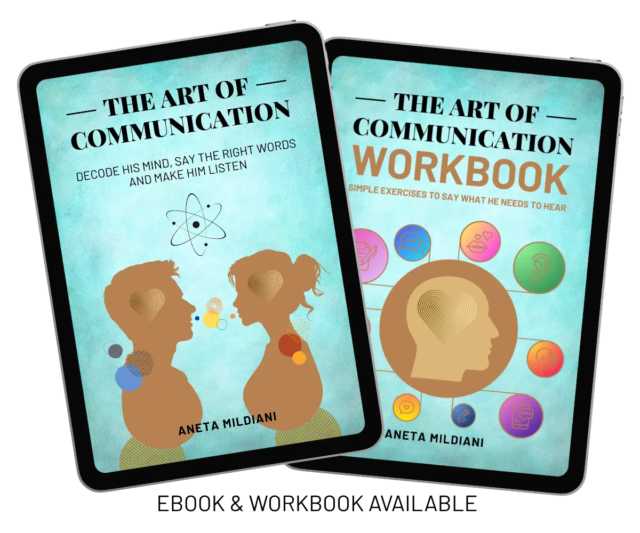
That’s exactly why I created my eBook The Art of Communication: Decode His Mind, Say the Right Words and Make Him Listen.
In this guide, I teach you how to translate your emotions into language a masculine heart can receive. I explain how to express needs without sounding needy, how to set boundaries without creating drama, and how to stay in your feminine energy even when you have something difficult to say. Because masculine and feminine minds are not wired the same. At times, it truly feels like we come from different worlds.
But when you understand how men listen and how they process, then your words stop being overlooked. They start landing with weight, intention, and warmth.
And that is the difference between a woman who talks and a woman who moves him. So, if you’ve ever felt misunderstood, dismissed, or emotionally shut down by a man – The Art of Communication is waiting for you!
Sources and further reading
- Ackerman, R.A., Donnellan, M.B. and Kashy, D.A. (2011) ‘Working with dyadic data in studies of emerging adulthood: Specific recommendations, general advice, and practical tips’, Emerging Adulthood, 19(4), pp. 481–499.
- Collins, N.L. and Feeney, B.C. (2004) ‘Working models of attachment shape perceptions of social support: Evidence from experimental and observational studies’, Journal of Personality and Social Psychology, 87(3), pp. 363–383.
- Cutrona, C.E. and Suhr, J.A. (1994) ‘Social support communication in the context of marriage: An analysis of couples’ supportive interactions’, Communication Research, 21(2), pp. 154–176.
- Feeney, B.C. and Collins, N.L. (2015) ‘A new look at social support: A theoretical perspective on thriving through relationships’, Personality and Social Psychology Review, 19(2), pp. 113–147.
- Lawrence, E., Barry, R.A., Brock, R.L., Bunde, M., Langer, A., Ro, E., Fazio, E., Mulryan, L., Rufino, K.A. and Dzankovic, S. (2011) ‘Perceived relationship quality and depressive symptoms: The role of self-esteem and conflict’, Journal of Family Psychology, 25(5), pp. 789–798.
Disclaimer
Every article in the Library is prepared with the highest level of diligence. I draw on my professional experience as a relationship coach, cross-check every claim with credible academic sources and review relevant scientific studies to ensure accuracy. I also make efforts to keep each article up to date, revising it whenever I find new evidence or updated research. My commitment is to provide readers with information that is both trustworthy and relevant, so you can read article based on facts, not trends. However, the rapid pace of scientific and clinical developments means that it may not reflect the most current knowledge available. Please also keep in mind, that reading an article does not constitute professional advice, as every situation is unique. If you are facing a serious personal challenge, you should seek guidance from a qualified professional.