






Table of Contents
- Why masculine men love deep connection?
- The feminine language that makes a man feel safe to open up
- Small moments that build trust more than deep talks
- What to avoid when trying to “get him to open up”?
- Feminine energy as the key to long-term intimacy
- Building connection without controlling it
- Sources and further reading
Why masculine men love deep connection?
You may assume that men who are strong, independent, or highly logical don’t crave intimacy the way women do. But the truth is more nuanced. Masculine men often long for deep emotional connection. They just don’t express it in ways that are easily recognized. In fact, many of them don’t even admit it to themselves.
Why? Because emotional connection requires a kind of openness that can feel dangerous to the masculine psyche. It’s not that he doesn’t feel. It’s that he’s been trained, often unconsciously, to protect himself from anything that might make him lose control, appear weak, or be seen as needy.
And so, he waits for safety, consistency and for something in your energy that tells him: You don’t have to perform here. You’re allowed to feel.
Masculine energy and the fear of vulnerability
Masculine energy is goal-oriented, protective, and deeply tied to structure. In many men, especially those who identify strongly with their role as a provider, leader, or protector, emotional vulnerability is not intuitive, it’s interpreted as exposure.
He may be deeply in love with you, yet still guarded. He may want to share his thoughts but filter every word before it leaves his mouth. Not because he doesn’t trust you, but because he’s not practiced in the language of intimacy. He doesn’t have a script for emotional openness, he has one for solving problems.
And unless he feels emotionally and energetically completely safe, he’ll likely default to silence, logic, or avoidance.
That doesn’t mean he’s cold. It means he’s masculine.
Why logic often hides emotional depth?
The masculine mind tends to prioritize order over expression. When a man is overwhelmed, confused, or unsure of his role, he’ll often shift into analysis rather than openness. He might give you solutions instead of sympathy, rational explanations instead of emotional attunement.
But don’t mistake this for emotional emptiness. In many cases, logic is his form of defense. It gives him the illusion of control in situations where he feels most exposed. And underneath that control is often a depth of feeling he doesn’t know how to navigate and sometimes doesn’t even know he’s carrying.
To reach that depth, he doesn’t need pressure. He needs presence. He needs a woman who communicates not with interrogation, but with invitation. Not “Why won’t you talk to me?” but “I’m here when you’re ready.”
That small energetic shift often makes all the difference.
The feminine language that makes a man feel safe to open up
Most women are naturals when it comes to expressing feelings. From a young age, they’re encouraged to speak, share, reflect. But what many don’t realize is that the language of emotional connection that works beautifully with other women can feel overwhelming or even threatening, to a highly masculine man.
The masculine doesn’t resist emotion because it lacks feeling. It resists emotion when it feels cornered by it. So, if a woman wants a man to open up, to share more, to emotionally bond, then she must learn to shift not just her words, but her entire emotional presence. That shift doesn’t require self-censorship. It requires self-awareness.
Speaking in a way that a masculine man can receive is not about being passive. It’s about being attuned. It’s about communicating in a rhythm that doesn’t just deliver a message. It keeps him emotionally regulated in the process.
Emotional availability vs emotional pressure
Many women confuse being open with being emotionally intense. They’ll pour their heart out, hoping the man will do the same. But what often happens instead is that he shuts down, goes quiet, changes the subject, or withdraws. Not because he’s insensitive, but because the interaction triggered a quiet kind of overwhelm in his nervous system.
For a masculine man, especially one raised in a culture that discourages emotional vulnerability, being asked to “talk about feelings” can feel as unnatural as being asked to speak a foreign language without warning. He may care deeply. He may want to connect. But if he doesn’t feel that the space is emotionally neutral, then he won’t risk it.
That’s why feminine energy is so powerful in these moments. Feminine energy doesn’t force. It invites. It offers presence, stillness, warmth that are signals that a masculine man subconsciously looks for when assessing whether he can let down his guard.
So if your instinct is to press harder, explain more, or ask repeatedly, try instead to soften your energy. Soften your voice. Say less and observe more. Because sometimes, the safest space for a man isn’t made of words at all. It’s made of trust in the silence between them.
How to speak in ways he can actually receive?
To emotionally connect with a masculine man, you don’t need to be perfect. You need to be clear, and you need to speak in a way that respects the way he processes information.
That means short, grounded, emotionally contained messages often land better than long monologues. Saying “I missed you today. I feel calm when you’re around.” holds more power than “Why didn’t you call me back? I felt anxious. Are you losing interest?”
It’s not about suppressing your truth. It’s about packaging it in a way that doesn’t flood his system.
When a woman leads with her emotional tone instead of her emotional analysis, a man can stay present. He doesn’t feel under attack. He feels her without needing to solve her.
And that, more than anything, creates the doorway to emotional intimacy.
Because while men may not always respond the way women do, they feel more than they show. And when they feel safe, they slowly begin to reveal what they’ve kept buried.
That’s the magic of feminine language. Not in how much it says, but in how deeply it resonates.
Small moments that build trust more than deep talks
It’s easy to assume that emotional closeness comes from big, dramatic conversations, where everything is laid bare, hearts are poured out, and tears flow freely. But when it comes to building trust with a masculine man, the reality is often the opposite.
For him, emotional safety isn’t measured by intensity. It’s measured by consistency. By the space between the words. By the way he’s received in quiet, ordinary moments.
That means it’s not always your deep questions or raw vulnerability that bring him closer. Often, it’s how you greet him after a long day. How you respond when he’s silent. How you hold your own emotional center when his isn’t available. That’s where bonding begins.
Because in those micro-interactions, a man learns something essential:
With her, I don’t have to be more than I am.
The psychology of consistency and calmness
Masculine men live in a world that constantly demands performance – in work, achievements, and status. What they long for in intimate connection is the opposite of that: the freedom to rest. Not just physically, but emotionally. To let go of the need to impress. To simply be and still feel valued.
That’s why your calm presence matters more than your poetic words.
A woman who can offer emotional steadiness becomes magnetic not because she’s passive, but because she creates contrast. She becomes the quiet in his storm, the rhythm in his chaos. And when she doesn’t overreact, overexplain, or overfunction, then he learns that her love isn’t conditional on his mood or performance.
He relaxes into her. And without even realizing it, begins to trust her.
This is the beginning of emotional intimacy with a masculine man emotional stability in a relationship.
He doesn’t want to be impressed. He wants to feel at home.
Why emotional safety isn’t built with intensity?
Intensity is exciting, but it’s not the same as connection. You can have electric chemistry with someone and still not feel safe. You can have hours-long conversations and still feel alone. Because true emotional safety isn’t about how deep you go. It’s about how safe it feels to return.
Masculine men don’t always name what makes them open up. But one thing is consistent: they open when they feel they won’t be punished for being imperfect. When they feel that their silence won’t be used against them. That their confusion won’t make you spiral. That they can breathe without being asked to explain it.
That’s why small moments matter more than grand declarations:
- When he comes home late and you smile instead of interrogate.
- When he pulls away for a day and you stay rooted instead of reactive.
- When he fails to deliver and you respond without attack.
Each of those moments tells him something more powerful than words ever could:
She doesn’t need me to perform in order to feel safe with me. So maybe I can be safe with her, too.
What to avoid when trying to “get him to open up”?
One of the most common misunderstandings in relationships with highly masculine men is the belief that emotional openness can be induced through confrontation or persistent questioning. While the intention may come from a place of care, the psychological impact is often counterproductive. That’s because emotional intimacy in men develops not through pressure, but through perceived safety, autonomy, and internal readiness.
Attempts to accelerate this process, especially through direct demands or emotionally charged conversations, can trigger withdrawal, shutdown, or reactive defensiveness. Not because the man is emotionally stunted, but because his attachment style and social conditioning often associate emotional disclosure with loss of control or perceived weakness.
Understanding the psychological mechanisms behind this reaction is essential if we want to create real change in relational dynamics.
Why pushing for emotions can trigger shutdown?
When a masculine man is asked to open up emotionally before he feels internally resourced to do so, his nervous system may register the request as a relational threat. This activates what in psychology is referred to as a protective deactivation strategy. It’s a form of emotional detachment used to regulate vulnerability and maintain control in uncertain interpersonal situations.
The more a woman insists, demands, or dramatizes the need for sharing, the more likely she is to be met with behaviors such as:
- Emotional stonewalling
- Logical deflection
- Sarcasm
- Passive resistance
- Sudden withdrawal of affection
These reactions are not random. They are symptoms of emotional flooding – a state where the individual feels overwhelmed by relational intensity and copes by disengaging. And for men with strong masculine energy, whose identity is built around competency and emotional composure, this flooding feels destabilizing.
In other words: he’s not avoiding her. He’s just avoiding dysregulation.
The difference between nurturing and fixing
Another common trap is attempting to “heal” a man emotionally by creating emotionally charged moments designed to make him feel safe. While this may seem nurturing, it often enters the territory of emotional micromanagement. The woman is no longer relating from her feminine core. She is performing emotional labor on his behalf.
This creates a parent-child dynamic rather than a polarity-driven adult bond. And for men, especially those with a suppressed or shame-based emotional template, this dynamic leads to internal resistance and disconnection, even if they care deeply.
The solution is not to stop being emotionally available. It’s to differentiate between presence and pressure.
A woman aligned with her feminine communication style creates space rather than urgency. She models emotional regulation rather than demanding reciprocity. And she remains connected to herself, regardless of his emotional pace.
This is what builds trust over time. Not interventions. Not emotional ultimatums. But a steady, regulated presence that gives the masculine space to emerge on his own terms.
Feminine energy as the key to long-term intimacy
In long-term relationships, emotional connection isn’t maintained by intensity or declarations. It’s sustained through energetic polarity and psychological attunement. For a woman in her feminine, the most powerful form of influence is not control, logic, or performance. It’s presence. A stable, emotionally mature, relational presence that nourishes without demanding, signals without overwhelming, and holds space without losing self.
Many women today feel conflicted between wanting deep intimacy and being told they need to “lean forward,” “speak up,” or “take charge.” While these strategies may offer short-term results, they are often incompatible with the nervous system of a man grounded in masculine polarity. For him, intimacy is not built through confrontation, but through what he perceives as emotional refuge.
And that refuge is rarely found in critique, instruction, or excessive emotionality.
It’s found in confidence, consistency and subtlety.
Being emotionally magnetic without being emotionally loud
Feminine energy is not about being passive or withholding, but about understanding the mechanics of attraction and emotional bonding from the male perspective. A woman in her feminine is not silent, but selective. She is not afraid to speak, but she knows when silence carries more weight than explanation.
Her emotional expression is not a flood. It’s a rhythm. She communicates through her nervous system as much as through her words. And because she remains regulated, responsive, and embodied, the masculine feels something rare: emotional safety without loss of power.
This dynamic allows him to remain in his natural energetic roles as a protector, while simultaneously deepening his emotional access. Because he’s not being pulled out of himself. He’s being invited toward her.
That’s how emotional intimacy with a masculine man becomes sustainable. Not because he is “fixed” or “trained,” but because she creates the environment where connection becomes his natural response.
Polarity and the art of soft power in relationships
Soft power is not manipulation, it’s influence without pressure. It’s the kind of psychological gravity that comes from being emotionally anchored and internally resourced. A woman who cultivates soft power doesn’t chase emotional outcomes. She becomes the space where depth happens without needing to control how or when.
Masculine and feminine polarity is not about strict roles, but about energetic complementarity. When she softens, he grounds. When she receives, he offers. When she feels deeply, but expresses selectively, then he begins to feel not coerced, but drawn in.
And that changes everything, because long-term intimacy cannot be forced. It must be evoked and sustained through a deep understanding of the psychological dynamics at play.
Building connection without controlling it
Deep connection with a masculine man doesn’t require control, it requires consciousness. Women often ask me: “What can I say to make him open up?” or “How do I get him to feel more?” But the truth is, emotional intimacy is not created through effort alone. It emerges when communication is aligned with polarity, timing, and psychological safety.
The paradox is simple: the more a woman tries to control the emotional outcome, the more the masculine resists. Not because he doesn’t want to connect, but because control feels like pressure, and pressure neutralizes attraction.
What creates lasting closeness is not intensity.
It’s relational intelligence. It’s emotional regulation. It’s a woman’s ability to respond, not react and to understand that masculine connection has its own rhythm, one that cannot be rushed or coerced, only invited.
This is where feminine strategy becomes powerful. Not through games, but through self-mastery. Not through emotional noise, but through calibrated presence.
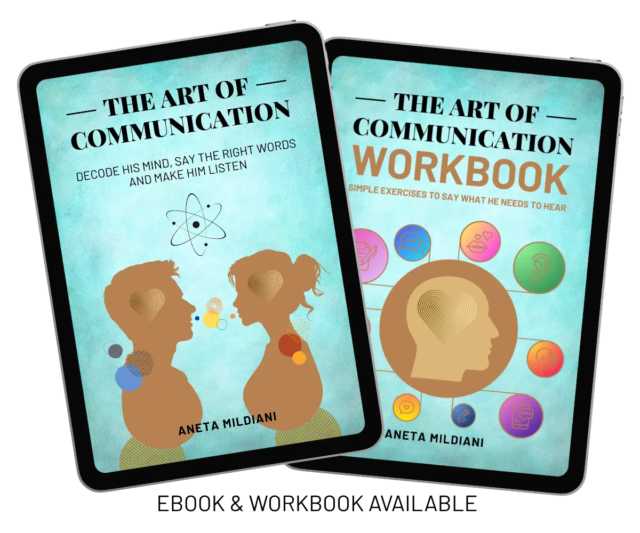
And that’s exactly why I created eBook The Art of Communication: Decode His Mind, Say the Right Words and Make Him Listen.
It was born from years of working with women who were smart, sensitive, and sincere — but still felt deeply misunderstood by the men they loved. Not because they lacked emotional depth, but because they didn’t yet speak in a way the masculine could receive.
Inside The Art of Communication, I teach how to speak with impact without being controlling. How to stay emotionally connected while remaining grounded. And how to use relational strategy to protect the feminine heart from unnecessary heartbreak.
Because men and women don’t connect in the same way.
But when you understand his psychology and trust your energy, intimacy stops being accidental and starts being inevitable.
Sources and further reading
- Barrett, L.F. (2017) How emotions are made: The secret life of the brain. Boston: Houghton Mifflin Harcourt.
- Gottman, J. and Silver, N. (2015) The seven principles for making marriage work. New York: Harmony Books.
- Gray, J. (1992) Men are from Mars, women are from Venus. New York: HarperCollins.
- Hendrix, H. (2008) Getting the love you want: A guide for couples. New York: St. Martin’s Griffin.
- Johnson, S.M. (2019) Attachment theory in practice: Emotionally focused therapy (EFT) with individuals, couples, and families. New York: Guilford Press.
- Lewis, T., Amini, F. and Lannon, R. (2000) A general theory of love. New York: Vintage Books.
- Perel, E. (2006) Mating in captivity: Unlocking erotic intelligence. New York: HarperCollins.
Disclaimer
Every article in the Library is prepared with the highest level of diligence. I draw on my professional experience as a relationship coach, cross-check every claim with credible academic sources and review relevant scientific studies to ensure accuracy. I also make efforts to keep each article up to date, revising it whenever I find new evidence or updated research. My commitment is to provide readers with information that is both trustworthy and relevant, so you can read article based on facts, not trends. However, the rapid pace of scientific and clinical developments means that it may not reflect the most current knowledge available. Please also keep in mind, that reading an article does not constitute professional advice, as every situation is unique. If you are facing a serious personal challenge, you should seek guidance from a qualified professional.