






Table of Contents
- Before you recognize a narcissist, you will feel it
- #1: He uses love like a weapon
- #2: He needs to be constantly admired
- #3: He gaslights you into doubting reality
- #4: He punishes you with silence
- #5: He gives you breadcrumbs, but never the whole loaf
- #6: He plays a victim when you set boundaries
- #7: He needs control, but calls it “love”
- #8: He shows traits of the Dark Triad
- You’re not crazy, you’re being conditioned
- Sources and further reading
Before you recognize a narcissist, you will feel it
Most relationships don’t begin with fear or uncertainty. They begin with deep, immediate connection, that is almost surreal in how right it feels. Perhaps that’s how it started between you and the man you’re with now. From the beginning, he made you feel special, almost divinely chosen. The way he looked at you, the way he listened was like he understood parts of you that no one else had ever touched.
But in cases we’ll talk about today, somewhere along the way, something shifted. Not in any obvious or dramatic way, but in small, hard-to-name moments. He started to pull away, not physically at first, but emotionally. You found yourself questioning whether you’d said something wrong, whether you were imagining the change, or whether you had simply become too needy.
Now, it’s not that he’s openly cruel. He doesn’t scream, he doesn’t throw things, he might even speak about love and loyalty. He likely tells you that you’re overreacting and you’re sensitive, that everything is fine and that you should be grateful for him. And yet, you keep feeling smaller, less certain, more anxious in his presence than you ever did before.
If you’ve started to wonder whether the way he treats you is truly love or whether it’s something more strategic, more manipulative, more toxic, then you’re not alone. And you’re not imagining it. Because some forms of psychological damage don’t come from overt abuse, but from a consistent distortion of reality, where your confidence is worn down, your intuition is silenced, and your identity begins to blur.
Today I will guide you through the most common signs of narcissistic behavior in romantic relationships. If even one of them feels familiar, it may be time to stop blaming yourself and start seeing the pattern for what it is.
#1: He uses love like a weapon
Some patterns in relationships are difficult to recognize because they can look like love, at least at first. When someone is expressive, intense, and emotionally invested from the beginning, it’s easy to assume that you’re being truly seen and deeply valued. But when this attention feels too fast, too much, or too perfect, it may be a sign that what you’re experiencing isn’t intimacy. It’s strategy.
In narcissistic dynamics, love becomes a tool. Not for building connection, but for gaining influence. It starts with idealization, moves quickly to emotional dependence, and shifts into withdrawal the moment you begin to feel secure. The result? You’re left wondering what happened and doing everything you can to bring back the version of him you first met.
What is lovebombing?
In some relationships, the beginning feels unusually intense. You may encounter a man who showers you with attention, compliments you constantly, speaks of a future together after only a short time, and makes you feel like you are the center of his emotional universe. The dynamic is often fast, passionate, and deeply flattering.
But while „lovebombing” may feel like deep connection, such behavior can also be an early sign of manipulation. What appears to be overwhelming affection might in fact be a calculated strategy to build dependence known as lovebombing. It is not driven by a genuine desire for closeness, but by a need to secure emotional control as quickly as possible.
Once that attachment is formed, the behavior often shifts. The man who once texted you every morning may suddenly become unavailable. His words become colder, his presence less predictable. Without explanation, you may feel like something changed and begin to question what you did wrong, or why the connection no longer feels safe or secure.
The pattern of intense idealization followed by sudden detachment is not a coincidence. It is a psychological strategy used to destabilize you. It creates emotional confusion and a craving for the version of him you met at the beginning, even if that version was never entirely real.
If you find yourself chasing the intensity that once made you feel special, hoping he will return to how he was “in the beginning,” it may be time to ask whether what you experienced was real affection or a form of emotional baiting designed to keep you hooked.
Intensity isn’t intimacy: Why you felt addicted from day one?
Fast emotional closeness can feel exhilarating, especially if you’ve gone through past relationships where you felt unseen, unchosen, or emotionally neglected. When someone suddenly makes you feel not only wanted but adored, it can be easy to confuse that experience with intimacy.
But emotional intensity is not the same as emotional safety. In fact, when it appears too early and too strongly, it often masks the absence of real intimacy. A narcissistic partner doesn’t want to build trust step by step. He wants access fast. And the best way to gain that is through intensity: overwhelming attention, dramatic declarations, and a flood of validation that can feel like emotional oxygen.
This is what makes the connection feel addictive. Your nervous system begins to link his approval to your sense of safety. You may start to fear his silence more than his disapproval. You begin to chase moments of closeness as if they are rewards for your performance and in doing so, you start to lose touch with your own emotional center.
If you felt pulled in from the start and now find yourself trying to earn back that early version of the relationship, it’s important to understand: this wasn’t love deepening. It was control beginning.
#2: He needs to be constantly admired
One of the less obvious signs of narcissistic behavior is the relentless craving for admiration. At first, it may look like confidence or charm. He might seem articulate, magnetic, or successful. But over time, you may begin to notice something more unsettling: while he thrives on being admired, he resists being truly known.
His sense of identity isn’t rooted in self-awareness, but in how others perceive him. He curates an image, not a connection. The moment admiration fades or you offer an honest reflection that doesn’t flatter, his mood shifts. Praise is welcomed. Intimacy, especially the kind that involves accountability, is not.
Praise feeds him, critique destroys him
A narcissistic partner doesn’t simply enjoy compliments, he depends on them to regulate his fragile self-image. His emotional equilibrium is sustained through validation. As long as you’re expressing admiration, things feel calm. But if you challenge him, even gently, the mask begins to crack.
You may notice that criticism, no matter how constructive, leads to disproportionate reactions: defensiveness, stonewalling, blame-shifting, or dramatic withdrawal. And so you start filtering your words. You avoid raising concerns. You become careful not to “ruin the mood.” Slowly, your emotional honesty gives way to emotional management.
What emerges is a relationship built not on mutual feedback, but on one-directional praise. You are expected to play the role of mirror reflecting only the version of him he wants to see.
He always talks more than he listens
In conversation, he takes the lead and rarely lets go of it. His experiences, his achievements, his opinions dominate most exchanges. If you try to share something personal, he finds a way to redirect the topic back to himself. Not always out of malice, but out of a deeply conditioned need to remain the center of attention.
At first, you might dismiss it as confidence. Over time, it begins to feel like invisibility. Your thoughts, your emotions, your inner life become secondary. You may notice that your needs are met with minimal curiosity, your vulnerabilities with impatience. Emotional support, if offered, feels obligatory or transactional.
When a man talks constantly but rarely listens, the relationship becomes a monologue. And in that monologue, you stop speaking freely. not because you have nothing to say, but because it no longer feels like anyone’s listening.
#3: He gaslights you into doubting reality
One of the most destabilizing experiences in a toxic relationship isn’t open conflict, but the quiet unraveling of your own perception. Narcissistic partners don’t always attack directly. Instead, they undermine slowly by questioning your memory, your emotional responses, or even your grasp on basic facts. Over time, you no longer trust your instincts. You begin to defer to his version of events, even when it contradicts what you know you lived.
This manipulation has a name: gaslighting. And it’s one of the most corrosive forms of psychological control. Because it doesn’t shout. It whispers. It rearranges reality, not with force but with doubt.
You apologize more than you breathe
In a healthy relationship, responsibility is mutual. But in a narcissistic dynamic, one person ends up holding all the emotional tension. You might notice that you’re apologizing constantly, because it seems like the only way to maintain peace.
Over time, the apology becomes your default setting. You stop asking for clarification. You stop expressing discomfort. You begin to edit yourself, avoid triggering him, and question whether your reactions are too much.
This is how gaslighting works. It creates a dynamic in which your emotional responses are weaponized against you. You become the problem, not because you are, but because you noticed one.
He redefines every fight to make you the problem
You bring something up and try to explain how something he said hurt you. And somehow, by the end of the conversation, you’re apologizing again. Not for what happened, but for how you felt. For your tone. For your timing. For making things uncomfortable.
A narcissistic partner rarely accepts responsibility unless it serves him strategically. When you challenge him, he reframes the conversation to focus on your reaction. You were too emotional, too dramatic and sensitive. And if you remain calm, then you were cold, unfeeling, detached.
Every attempt at resolution becomes an emotional hall of mirrors. You begin to wonder if you’re imagining things. You may even start to believe that your standards are unrealistic or that love always requires this much internal rewriting.
But it doesn’t. And it shouldn’t.
#4: He punishes you with silence
There are many ways to hurt someone. Words can cut. Actions can betray. But sometimes, the most effective form of harm leaves no trace at all. It doesn’t shout. It doesn’t slam doors. It doesn’t leave bruises on the skin, only on the soul. In toxic relationships, silence isn’t always a moment of reflection. It’s a method of domination.
A narcissistic partner may not always fight loudly, but he knows exactly how to create pressure through absence. He retreats without explanation. He withholds affection without warning. He watches as you spiral in self-doubt and waits until you break the silence, because you always do. This isn’t conflict resolution. This is behavioral conditioning.
And over time, you learn the rules without ever hearing them spoken.
The silent treatment is power
There is a silence that heals. It holds space for two people to calm, think, and return to each other with more clarity. But the kind of silence often used by narcissists has nothing to do with calm. It is designed to destabilize. It creates emotional tension without resolution. You don’t know what he’s thinking, when it will end, or what invisible rule you broke to deserve it.
You may find yourself replaying every recent moment, analyzing each sentence, each look, each sigh, wondering what shifted. But this isn’t about clarity. It’s about control. When silence is used deliberately, it becomes a weapon. It allows him to assert dominance without appearing aggressive. It makes you feel like the one who ruined everything, simply because you dared to speak, feel, or ask for something.
And what begins as a moment of disconnection quickly turns into a ritual: you upset him, he shuts down, and the only way to restore contact is for you to give in. The longer you wait, the more pressure builds. Until eventually, you fold. You apologize. You soften. You reach for him, even if he’s the one who disappeared.
This is not peaceful conflict management. It’s psychological training. You are being taught that love can be withdrawn at will and that your value is conditional.
You beg for connection that should be natural
Connection in a healthy relationship flows naturally. It doesn’t need to be purchased through apology or performance. You don’t have to plead for affection, reassurance, or conversation. But in a narcissistic dynamic, those basic needs become bargaining granted or denied chips depending on how well you play the unspoken game.
At some point, you may notice yourself becoming smaller. You don’t speak up as much. You avoid sensitive topics. You stop expressing needs that once felt obvious. Not because you’ve lost them, but because asking now feels dangerous. Because silence doesn’t just remove his words. It removes your voice, too.
What’s especially painful is the way this kind of silence makes you question yourself. You may wonder if you’re too emotional, too needy, too dramatic. You may convince yourself that you’re overreacting and that needing consistency is somehow asking for too much. But it isn’t.
You were never supposed to work this hard just to feel heard. Emotional intimacy isn’t a prize to be earned through obedience. If you find yourself constantly striving to win back a man’s attention after he’s deliberately withdrawn it, what you’re experiencing is not love, it’s punishment disguised as distance.
And the more you chase after connection that should be freely given, the more your sense of self erodes.
#5: He gives you breadcrumbs, but never the whole loaf
Some relationships don’t end in betrayal or violence. They erode through unmet expectations. You stay, not because you’re happy, but because every time you’re ready to walk away, he gives you just enough to keep your hope alive. A kind word, a short message or a compliment when you’re doubting yourself. And for a moment, you feel reconnected.
But then he disappears again, becomes vague, distracted and cold, until the next crumb appears.
This is what breadcrumbing looks like in long-term dynamics: minimal emotional input that keeps you emotionally invested, but never truly fulfilled. It’s not the absence of love that’s most painful. What hurts the most is the illusion of it, given in carefully controlled doses.
He comes close just to keep you hooked
A narcissistic partner often senses the moment you begin to emotionally detach. And instead of letting the distance grow, he offers something that looks like change. A deeper conversation. A shared memory. A sudden burst of affection. It doesn’t last and it’s not deep, but it’s enough to pull you back in.
You might find yourself thinking, “Maybe this time it’s real.” You replay his words, magnify the gesture, and push aside the last six weeks of emotional absence. This isn’t naïveté. It’s neurological conditioning. You’re being trained to respond to inconsistency like a reward, because when connection is unpredictable, you value it more.
But this kind of closeness isn’t love. It’s bait. And it’s being used to keep you emotionally available without ever offering the full safety of commitment, clarity, or true reciprocity.
You’re waiting for the version of him that doesn’t exist
One of the hardest parts of a breadcrumbing dynamic is that it builds its power on memory. You’re not just missing him. Actually, you’re missing who he was during those rare, magical moments when he showed up fully. You begin to build your emotional future around a version of him that only appears when he wants to keep you from walking away.
So, you stay. You tolerate the cold days for the one good weekend. You accept the detachment because every once in a while, he says the right thing. You silence your doubts because “you’ve seen who he can be.” But the question is not who he can be for a moment. It’s who he chooses to be consistently.
If you’re living on crumbs, it’s not because you’re weak. It’s because you’ve been conditioned to feel grateful for them. And breaking that spell doesn’t begin with him changing. It begins with you no longer chasing something that never belonged to you in the first place.
#6: He plays a victim when you set boundaries
There are people who can’t handle the word “no”. Not because they don’t understand it, but because it challenges their entire system of control. For a narcissistic partner, boundaries aren’t healthy limits. They are personal attacks. And when you begin to assert them, even gently, he doesn’t adapt. He reverses the narrative and paints himself as the one being wronged.
This tactic can be disorienting. You try to communicate your needs, and suddenly you’re accused of being unloving, cold, or selfish. What begins as a simple request for space, honesty, consistency, later becomes a full-blown emotional reversal. He’s not the one hurting you. You’re the one hurting him.
This pattern isn’t miscommunication. It’s emotional manipulation. And it ensures that the more you try to protect yourself, the more guilty you feel for doing so.
He twists your limits into personal attacks
Maybe you asked for a night alone. Maybe you said no to a plan that felt uncomfortable. Maybe you spoke up about how his behavior made you feel. Instead of engaging in dialogue, he reacts as if you’ve betrayed him. He may grow silent, distant, or dramatically hurt. He may accuse you of pushing him away and of “ruining everything.”
This response is not about your request. It’s about power. When a narcissist twists your boundaries into rejection, he positions himself as the victim of your emotional independence. And once that role is claimed, it’s no longer safe for you to protect yourself without being punished.
So, you shrink and soften. You tell yourself it wasn’t that big of a deal. And over time, your boundaries disappear, not because they stopped mattering, but because he made you feel like a monster for having them.
He cries and accuses you of being cold
Emotional expression can be real. But it can also be performative. One of the more confusing tactics in a toxic dynamic is when a narcissistic partner responds to your limits with emotional breakdown followed by subtle blame.
He might cry, talk about abandonment, speak of childhood trauma, or describe how hard he tries. And in that moment, your heart opens. You lower your voice. You begin to feel like you’ve hurt him through honesty.
But once you’ve softened, the mood shifts. He reminds you of how cold you were. He asks why you had to be so distant. And just like that, the focus is no longer on what prompted the boundary, but on how uncomfortable he felt when you asserted it.
This is the trap: boundaries are cast as betrayal. Empathy becomes a weapon. And you end up overcompensating for a pain that wasn’t caused by your limit, but by his inability to tolerate it.
#7: He needs control, but calls it “love”
Control doesn’t always look like dominance. It can wear the face of care, concern, even devotion. In relationships shaped by narcissistic behavior, control is often masked as affection and that’s what makes it so hard to name. The gestures feel thoughtful. The rules are framed as protection. The limits are presented as love.
But over time, these patterns may begin to restrict rather than support. What starts as closeness can gradually turn into monitoring. What’s offered as guidance can shift into correction. And what once felt like passion can begin to feel like surveillance.
This isn’t about control through force. It’s about influence wrapped in emotional language. It’s subtle, persuasive and deeply disorienting.
He monitors, corrects and manipulates your choices
In some dynamics, everyday decisions are no longer fully yours. The clothes you wear, the people you see, how you spend your time – each of these may be questioned, evaluated, or challenged. At first, it might sound like concern. He might say he just wants what’s best for you. But the emotional atmosphere starts to shift. You begin to adjust, not because you agree, but because you’re trying to avoid disapproval.
The correction isn’t always direct. Sometimes it comes through passive remarks, disapproving looks, or sudden withdrawal of warmth. The more you shift your choices to accommodate his preferences, the less you feel anchored in your own.
When control is disguised as care, it becomes harder to resist, because it doesn’t feel like pressure. It feels like intimacy. But true intimacy doesn’t require you to erase your autonomy to feel accepted.
You feel smothered, but still not enough
There is a unique emotional dissonance that can emerge when someone is overly involved in your world, but emotionally distant at the same time. The partner may want to know everything, influence everything, shape everything, yet still leave you feeling unseen, unmet, or fundamentally alone.
In such a dynamic, closeness doesn’t bring safety. It brings exhaustion. You may find yourself constantly adjusting, explaining, second-guessing, managing his moods and still feeling like you’re not doing enough to prove your loyalty.
This is the hallmark of psychological control: it creates the illusion that the relationship is intense because it’s meaningful, when in fact it’s intense because it’s unbalanced. The more you give, the more is required. And the more is required, the less room remains for who you are.
#8: He shows traits of the Dark Triad
Some personalities don’t just create confusion, they operate on a deeper structure of manipulation. In psychology, there is a term for a group of traits that, when combined, form a particularly dangerous pattern in intimate relationships. This trio is known as the Dark Triad: narcissism, Machiavellianism and psychopathy.
These traits can show up subtly or dramatically, but when they begin to intertwine, they often leave behind a trail of emotional damage and self-doubt in others.
The danger of the Dark Triad doesn’t lie in one specific act, it lies in the emotional atmosphere it creates. Charm mixed with coldness. Generosity paired with calculation. Affection followed by cruelty. This instability isn’t random. It’s part of a system that keeps the other person emotionally destabilized and easier to influence.
Narcissism, Machiavellianism and subtle cruelty
Each element of the Dark Triad brings its own form of harm. Narcissism demands admiration. Machiavellianism uses strategy and manipulation to control outcomes. Psychopathy, often misunderstood, isn’t always violent. It can be the lack of empathy, the inability to connect to your pain, or the enjoyment of power without conscience.
When these traits overlap in a romantic relationship, it becomes difficult to know what’s real. The partner may seem attentive, intelligent, or even protective, but underneath is a pattern of calculated behavior. Emotional withdrawal used as discipline. Generosity used to buy silence. Kindness given in just enough doses to confuse your instinct to leave.
This dynamic doesn’t always show up in extremes. That’s what makes it dangerous. You’re not reacting to obvious abuse, but to inconsistency, to mixed signals, to kindness that turns on you the moment you assert yourself.
It’s not just selfishness, it’s strategy
Not all difficult partners are narcissists. Not every emotional wound comes from manipulation. But when certain patterns repeat and when control is consistent, when your feelings are weaponized, when his behavior is strategic rather than reactive, then it may point to something more intentional.
This isn’t about labelling someone with a diagnosis. It’s about recognizing when your emotional safety is being compromised by a system designed to keep you unstable. When someone uses your empathy against you, when they charm your friends while eroding your confidence behind closed doors, that’s not just difficult. That’s dangerous.
Being aware of the Dark Triad doesn’t mean you have to diagnose your partner. It simply means you start trusting your pattern recognition. You notice when the charm is too polished, when the attention is too calculated, and when your instincts are telling you something your heart may not want to believe yet.
If you want to know much more about the Dark Triad I make a breakdown of of it in article The Allure of the Dark Triad: Why Some Women Can’t Resist Bad Boys?
You’re not crazy, you’re being conditioned
You don’t need a diagnosis to recognize what’s harming you. You don’t need a label to justify the ache in your chest, the tension in your gut, or the dull exhaustion that comes from managing someone else’s chaos.
If you’ve found yourself monitoring your words, suppressing your intuition, or questioning your reality more than usual, then something isn’t right. And that something isn’t you.
Recognizing these patterns doesn’t make you paranoid. It makes you precise. The moment you name them, you stop participating in your own erosion. You begin, piece by piece, to re-enter yourself. Your voice. Your clarity. Your right to respond, rather than explain.
Narcissists not always destroy you in one blow. They wear you down slowly through subtle withdrawal, performative affection, manipulative logic, and emotional confusion. And when these tactics are used consistently, they change you. Not because you’re weak, but because your nervous system is adapting to survive what should never have been required.
But adaptation is not love. And surviving is not the same as living.
You don’t need to diagnose your partner or justify your intuition with facts. If something feels wrong, if your energy is constantly being siphoned into decoding someone else’s behavior, you’re allowed to stop and ask: What is this really costing me?
If any of the signs you’ve read here feel familiar, you’re not alone and you’re not imagining it. But you don’t have to stay in confusion and keep giving chances to someone who’s only offering chaos in return.
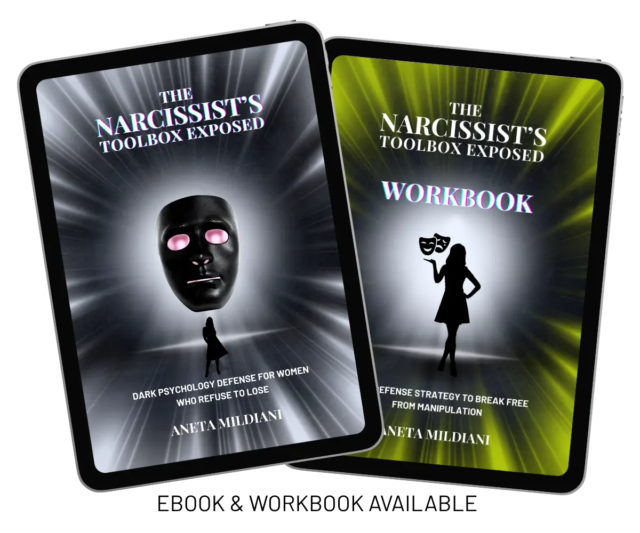
That’s why I created eBook The Narcissist’s Toolbox Exposed: Dark Psychology Defense for Women Who Refuse to Lose. It’s a structured, grounded resource for women who need to see clearly again.
It’s a clear, comprehensive breakdown of 32 toxic behaviors commonly used by narcissistic partners – from love-bombing to gaslighting, from hot-and-cold patterns to the long-term effects of the silent treatment. But more importantly, it teaches you how to recognize, name, and protect yourself from each one without drama, without fear and without waiting for permission to take your power back.
This isn’t just information. It’s restoration.
For many women, reading this guide is the moment things finally click. The moment they stop trying to fix what was never in their control and start rebuilding their inner stability without guilt.
If anything in this article felt familiar, you’re not alone and you’re not weak. You’ve simply been navigating a dynamic that’s designed to make strong women feel confused.
Let that clarity be the beginning of your boundary.
Sources and further reading
- Bowlby, J. (1988) A Secure Base: Parent-Child Attachment and Healthy Human Development. New York: Basic Books.
- Feeney, J.A. & Noller, P. (1996) Adult Attachment. London: Sage.
- Guerrero, L.K. & Floyd, K. (2006) Nonverbal Communication in Close Relationships. Mahwah, NJ: Lawrence Erlbaum Associates.
- Le, B. & Agnew, C.R. (2001) ‘Need fulfillment and emotional experience in interdependent romantic relationships’, Journal of Social and Personal Relationships, 18(3), pp. 423–440.
- Pistole, M.C., Roberts, A. & Mosko, J.E. (2010) ‘Commitment predictors: Long-distance versus geographically close relationships’, Journal of Counseling & Development, 88(2), pp. 146–153.
- Stafford, L. (2010) ‘Geographically separated relationships’, in Miller, R.S. (ed.) Intimate Relationships. 6th edn. Boston: McGraw-Hill, pp. 311–333.
Disclaimer
Every article in the Library is prepared with the highest level of diligence. I draw on my professional experience as a relationship coach, cross-check every claim with credible academic sources and review relevant scientific studies to ensure accuracy. I also make efforts to keep each article up to date, revising it whenever I find new evidence or updated research. My commitment is to provide readers with information that is both trustworthy and relevant, so you can read article based on facts, not trends. However, the rapid pace of scientific and clinical developments means that it may not reflect the most current knowledge available. Please also keep in mind, that reading an article does not constitute professional advice, as every situation is unique. If you are facing a serious personal challenge, you should seek guidance from a qualified professional.