






Table of Contents
- Why long-distance relationships are so hard?
- Danger #1 – The temptation to cheat
- Danger #2 – Jealousy and lack of trust
- Danger #3 – The slow fade: When love starts to die
- Danger #4 – Silence, distance and the death of connection
- Danger #5 – Disappointment after finally living together
- Danger #6 – Online-only love with no real-life proof
- Sources and further reading
Why long-distance relationships are so hard?
In the last few years, long-distance relationships have become more common than ever. We meet online, we travel for work, we fall in love across cities, countries, and even continents. Sometimes it’s just a temporary phase. Maybe you moved for school, for family, for a new job. Sometimes you’ve never even met in person yet, but your connection feels real and intense.
No matter how your long-distance relationship began, one thing is certain: it requires a different kind of strength. Not just romantic hope, but emotional endurance. Not just communication, but psychological resilience. And while the world may feel more connected than ever, the space between two people in love can still feel endless, especially at night, when you need someone close and they’re not there.
Have you ever laid in bed staring at your silent phone, wondering if he fell asleep, or if he just didn’t feel like talking tonight? Have you ever read too much into a short text, or spent hours holding yourself back from double texting, because you didn’t want to seem “too much”?
If you have, you’re not alone. Long-distance relationships can make even the most grounded, self-assured woman feel unsure of herself. And it’s not because there’s anything wrong with you, but because love, when stretched across cities or countries, starts to live more in your mind than in shared, everyday reality. And that makes everything more intense.
When you don’t see him often, every word matters more. Every silence, too. Your brain tries to fill in the gaps: Why hasn’t he called? Is something wrong? Is he losing interest? Or is it me? This emotional hypervigilance is exhausting and yet, it becomes a new normal.
What makes long-distance relationships especially challenging isn’t just the miles between you. It’s the way those miles slowly affect your confidence, your patience, and sometimes even your sense of reality. Without regular physical closeness, a relationship starts relying entirely on communication and when communication slips, so does your sense of emotional safety.
You might start to wonder whether what you’re building together is strong enough to survive the time apart. Whether you’re still on the same page. Whether the bond you feel is mutual… or mostly in your head. That’s not insecurity talking, but an erosion of connection that happens when love doesn’t have a chance to breathe side by side.
If you’ve felt that slow ache, the kind that builds when you miss someone so much it makes you question everything, then you’re in the right place. Because long-distance relationships can work. But only when you know what can destroy them.
Let’s talk about those dangers clearly, honestly and without shame.
Danger #1 – The temptation to cheat
One of the most painful and unspoken challenges in long-distance relationships is the pull toward emotional intimacy with someone outside the relationship. It rarely starts as a conscious decision. Often, it begins with loneliness that settles in when your partner isn’t there for the small moments, the comforting words, or the reassuring glance that says “I’m here with you.”
Without physical closeness, our nervous system loses a powerful form of regulation. Proximity isn’t just about logistics, but it’s part of how we feel safe and loved. According to attachment theory, long periods without access to a partner’s presence can trigger anxiety, doubt, and heightened sensitivity to emotional disconnection. That’s not weakness. It’s human wiring.
The tricky shift of emotional loyalty
In this space of distance and longing, the mind naturally searches for relief. Sometimes it finds it in distractions, in new conversations, in a comforting connection with someone who listens and responds more promptly than the person who’s far away. These interactions may begin innocently, but they can gradually evolve into something emotionally significant; something that competes with the existing bond.
This doesn’t always look dramatic. There may be no secrets, no betrayal in the traditional sense. But when emotional energy is directed more consistently toward someone else, a shift begins. Over time, the partner who was once the center of emotional gravity starts to feel peripheral. And even without a decisive moment of “cheating,” the relationship suffers a quiet breach of trust.
When emotional depletion creates vulnerability
The risk of emotional drift increases when the long-distance dynamic lacks structure. If there’s no clear sense of when or how the distance will end – no shared timeline, no realistic plan – then the emotional toll becomes heavier. The uncertainty begins to feel permanent. And in that state, even the strongest commitment can start to weaken.
Temptation in this context isn’t a sign of immorality. It’s often a sign of emotional depletion. When you feel disconnected, unprioritized, or forgotten, your mind naturally reaches for a sense of closeness, even if it’s just for a moment. The key is not to judge yourself for that longing, but to understand what it’s asking for.
Redirecting the energy inward
Identifying the real need behind the temptation allows you to address it constructively. Sometimes it’s about asking for more presence, more reassurance, or more clarity from your partner. Other times, it’s a sign that the relationship needs new agreements, or even a deeper conversation about whether the distance still serves both people.
Long-distance love is vulnerable to outside influences not because it’s shallow, but because it lacks the protective rituals that keep ordinary relationships emotionally nourished. When those rituals are missing, intentional repair and open dialogue become essential. Without them, the temptation to drift can become the beginning of disconnection.
Danger #2 – Jealousy and lack of trust
Trust is one of the most fragile elements in any relationship, but in long-distance dynamics, it becomes the very foundation on which everything else is built. When you cannot see each other regularly, when you don’t share the rhythm of everyday life, and when most of your communication happens through a screen, trust is no longer just a feeling. It becomes a daily decision.
What complicates matters is the natural presence of uncertainty. You don’t know who your partner is spending time with, how his mood really is today, or what subtle things might be shifting between you without being said aloud. You rely on words to fill in the emotional gaps. And when those words feel delayed, unclear, or too few, the mind begins to wander.
When attachment anxiety takes over
Jealousy is not always about possessiveness. More often, it stems from attachment anxiety – a fear that the emotional bond you cherish is under threat, whether real or imagined. When physical closeness is missing, the brain compensates by scanning for possible signs of disconnection. This heightened vigilance can quickly turn into obsessive thought loops: Who is he with right now? Why did he sound distant today? Has something changed?
In many cases, jealousy in long-distance relationships isn’t sparked by evidence, it’s activated by absence. The silence, the waiting, and all the unknowns become fertile ground for projection. And the more anxious you feel, the more tempted you are to monitor, control, or test the relationship to regain a sense of certainty.
When reassurance turns into pressure
Unfortunately, this creates a paradox. The very attempts to feel closer like asking more questions, seeking reassurance, or expressing fears can begin to feel suffocating to the other person. What starts as an effort to connect may come across as pressure, and instead of bringing the two of you together, it can create defensiveness, withdrawal, or frustration.
Breaking this cycle requires more than reassurance. It requires clarity. Clarity about what kind of communication you both need, how often you expect to check in, and what each of you interprets as emotional availability. In long-distance relationships, assumptions are dangerous. What feels normal to one partner may feel neglectful to the other.
Learning to live with emotional ambiguity
Building trust at a distance also means learning to tolerate a certain level of emotional ambiguity without immediately translating it into rejection. Not every delay means disinterest. Not every quiet day is a warning sign. But when doubts do arise, they deserve to be voiced calmly and clearly, rather than turned inward as silent suspicion or outward as accusation.
Jealousy, when understood, can be transformed into insight. It tells you where your wounds are, where your needs live, and what kind of emotional safety you require in love. But when it’s left to grow in silence, it slowly reshapes how you see your partner and yourself.
If your long-distance relationship is to thrive, it needs more than trust. It needs transparent, emotionally literate communication that honors both vulnerability and responsibility. That’s not always easy, but it is possible. And it’s worth the effort.
Danger #3 – The slow fade: When love starts to die
There is a particular kind of pain that comes not from arguments or betrayal, but from the slow disappearance of something that once felt vivid. In long-distance relationships, this slow fade often begins unnoticed. The messages are still coming, but they’re shorter. The calls still happen, but they feel less alive. Your partner hasn’t left, but something between you has started to go quiet.
One of the most subtle dangers in long-distance love is this quiet decline of emotional energy. At first, everything feels intense – conversations run deep, emotions feel magnified, the longing fuels passion. But over time, if the connection isn’t actively nourished, the same longing that once brought you closer can begin to turn into emotional fatigue.
The weight of repetition without presence
Emotional fading is tied to how we regulate emotional intimacy. Relationships need rhythm, presence, and reciprocity. Without shared experiences and spontaneous interactions, the relationship begins to rely heavily on planned communication. But scheduled connection can start to feel like obligation rather than desire and when that happens, the emotional tone changes.
You may begin to notice that your partner responds with less warmth. The curiosity in his voice fades. He no longer asks follow-up questions. The conversations become practical, transactional. You start to wonder if something’s wrong, but you can’t quite name it. There’s no specific moment of change, only a growing absence of what once felt natural.
Misinterpreting quiet withdrawal
This process doesn’t always mean that your partner has stopped caring. Often, it reflects emotional depletion on both sides. Keeping love alive at a distance requires effort that few people are prepared for in the long term. The lack of physical rituals like small gestures, shared space, and everyday routines begins to wear down even strong bonds. And when emotional needs go unmet for too long, interest doesn’t vanish dramatically. It just fades.
What makes this especially painful is that you’re not always sure whether to bring it up. Is it just a phase? Is he just tired? Will saying something make it worse? You may find yourself trying harder to spark his attention with sending longer messages, suggesting video calls, or asking deeper questions, only to be met with vague replies or emotional flatness. And every time he doesn’t respond the way you hoped, a small part of you pulls back.
Reclaiming emotional closeness before it’s too late
To address this slow fade, you need honesty, both with him and with yourself. Are you both still emotionally invested? Are you showing up fully for each other, or are you simply maintaining contact out of habit? These are difficult questions, but necessary ones. Pretending that everything is fine only accelerates the drift.
Emotional connection doesn’t sustain itself. It requires intention, consistency, and mutual presence, even when the distance makes it inconvenient. If you’re noticing a decline, don’t wait for it to reverse on its own. Start the conversation. Not with blame, but with clarity: “I feel something has changed, and I miss how we used to connect.”
Because sometimes, naming the silence is what brings the relationship back to life. And sometimes, it reveals a truth that needs to be faced.
Danger #4 – Silence, distance and the death of connection
Not every relationship ends in a fight. Some end in silence, not the comfortable one, but the kind that settles in when two people stop reaching for each other. In long-distance relationships, silence can be especially dangerous, because it rarely feels dramatic. It arrives gradually, almost politely. The replies come later. The messages get shorter. The calls become fewer. And eventually, there’s nothing left to say that hasn’t already been said.
Unlike emotional disconnection, which can still carry a trace of conflict or intensity, silence signals something more passive – a kind of emotional disengagement that is harder to notice, and therefore harder to interrupt. It doesn’t mean that your partner has stopped caring entirely, but it may mean that the relationship has slipped into the background of his emotional life.
When nothing feels worth saying anymore
Connection requires ongoing reciprocity. Without it, the mind begins to adapt. When conversations no longer feel meaningful, and when your emotional bids go unanswered, your nervous system learns to expect less. You check your phone less often. You stop initiating. You hesitate before calling. Eventually, you begin to protect yourself from disappointment by withdrawing first.
What makes this dynamic so painful is that it often happens when no one wants to be the one to admit what’s changing. You might tell yourself your partner is just busy. You might wait for him to text, assuming he’ll notice your silence. But as both of you lower your expectations and reduce your efforts, the relationship becomes emotionally uninhabited. Still technically there, but no longer lived in.
When communication becomes mechanical
This pattern is common in long-distance love, especially when both partners are overwhelmed with other responsibilities. Without intentional rituals of connection, the relationship can fall to the bottom of the priority list. And because there’s no visible conflict, no clear rupture, you might feel like you have no “reason” to bring it up. But the absence of connection is reason enough.
One of the most important skills in sustaining a long-distance relationship is recognizing when communication has become hollow. Not just infrequent, but lacking emotional substance. If your partner speaks to you regularly but you no longer feel seen, heard, or moved by those exchanges, that’s not communication. That’s maintenance.
When silence becomes the loudest sign of all
Rebuilding connection after silence requires more than simply restarting the usual rhythm. It means asking difficult questions: Are we still emotionally present for each other? What do we need to feel close again? What kind of interaction would feel nourishing, rather than just habitual?
The death of connection rarely announces itself. It happens when both people assume the other is fine with the distance. But love doesn’t fade all at once. It unravels slowly in unsent messages, conversations cut short, and evenings spent waiting for a call that never comes.
If you feel that silence growing between you, don’t wait for it to become permanent. Sometimes, the most loving thing you can do is say the thing neither of you wants to admit: that you miss what you used to have and that you want to fight for it.
Danger #5 – Disappointment after finally living together
When you’ve spent months, or even years, loving someone from a distance, living together can feel like the long-awaited reward. You imagine quiet mornings, shared meals, the comfort of finally falling asleep in the same bed. And while many of these things do happen, they’re often accompanied by something less expected: friction. Subtle, persistent, sometimes confusing. Not because love is missing, but because daily life, unlike fantasy, is made of routines, habits, and human imperfections.
One of the least talked-about risks in long-distance relationships is the emotional dissonance that arises when you finally merge your lives physically. Until now, your connection has existed in curated moments: weekend visits, video calls, messages exchanged at your best and most intentional. You didn’t see each other during the boring parts of the day. You didn’t share space when you were irritable, tired, distracted, or unmotivated. The emotional rhythm was built on anticipation and effort, not on mundane repetition.
From independent routines to emotional collisions
When you do finally move in together, it’s not uncommon to feel… surprised. Not necessarily disappointed in the relationship, but unsettled by the sheer weight of real, unfiltered cohabitation. You see his habits up close – the way he leaves dishes in the sink, forgets to close drawers, or scatters laundry on the floor. You hear how he breathes when he sleeps. You notice things you’ve never had to live with before, and suddenly, love becomes less about longing and more about navigating closeness.
This isn’t a sign that something is wrong. It’s a natural psychological adjustment. When you’ve lived alone for a long time, your home becomes an extension of your autonomy. You create micro-routines, emotional zones, and predictable flows that give you comfort. Introducing another person, even someone you love, can feel like an intrusion into that carefully managed balance. You may find yourself irritated by things that seem objectively small. But they’re not small to your nervous system. They signal change. And change always brings a degree of tension.
What fantasy can never prepare you for
The deeper issue here is that your mind has likely built an idealized version of what “living together” would feel like. This is not naive, it’s human. When we miss someone, we fill the gaps in with hope. We imagine that closeness will fix the distance. But what it actually does is reveal everything the distance kept hidden.
Emotional intimacy becomes physical presence. And presence, as beautiful as it is, removes the buffer. You can no longer disconnect when you’re upset. You can’t curate your responses. You wake up next to each other with all your moods, needs, and inconsistencies in full view. And that kind of exposure, while vulnerable and real, can feel overwhelming.
Building something real from daily imperfections
The key is not to interpret this shift as failure. Discomfort in transition doesn’t mean the love was an illusion. It means you’re now entering a new phase of relationship that requires adjustment, communication, and realistic expectations. Instead of mourning the fantasy, it’s time to build the real version of your life together.
You won’t always like how he loads the dishwasher. He won’t always understand why you need space after a long day. But these frictions are not signs of incompatibility. They’re invitations to learn each other anew, beyond the long-distance lens.
Love doesn’t collapse under the weight of socks on the floor or toothbrushes left out. It collapses when those things become symbols of disconnection instead of starting points for empathy. If you can name the small irritations without weaponizing them, and express your need for adjustment without blaming, you’re far more likely to come out stronger on the other side.
Because true partnership begins not when you fall in love, but when you choose to keep loving through the ordinary.
Danger #6 – Online-only love with no real-life proof
There is something undeniably thrilling about falling for someone through a screen. The conversations feel deeper, the connection more intentional, and every message becomes a little spark of anticipation. For many women, meeting someone online is not a last resort, it’s a conscious choice, a way to connect beyond the limitations of geography or routine. And often, those connections are real, meaningful, and filled with hope.
But there’s also a risk that follows online-only love: strong emotional intensity that develops before reality has had a chance to catch up. You might talk every day, share secrets, exchange photos, even make plans for the future, but if you’ve never met in person, there’s a part of the relationship that still lives in possibility, not certainty.
In the age of filters, illusions grow faster
In today’s digital world, this is increasingly common. The platforms we use to meet people are sophisticated, accessible, and emotionally engaging. But at the same time, we are surrounded by new forms of deception. There are apps that can alter a person’s face even on live video. There are people who build entire fake identities, sometimes not to hurt, but to escape their own reality. And there are smart, careful and emotionally attuned women who find themselves deeply invested in someone who may not even exist.
This kind of attachment forms quickly. When we don’t have access to the full presence of a person, their body language, their scent, then our brain fills in the blanks. We build stories based on voice, imagination, longing. And the more we invest emotionally, the harder it becomes to ask difficult questions: Is this person truly who they say they are? Are they emotionally available, or simply entertained by the attention? Do their actions match their words?
Online dating isn’t the problem, lack of guidance is
Falling in love online isn’t wrong, it’s far from it. It can offer space to truly get to know someone before physical attraction clouds judgment. It allows for meaningful conversations, shared goals, and a slower, more conscious form of intimacy. But it also requires a very specific set of skills: discernment, emotional regulation, and a deep understanding of what makes a person ready for love, not just available for chat.
I’ve seen how many women fall into emotional chaos in this space. Not because they were naive, but because no one ever gave them the tools to navigate online dating with clarity and confidence. Over the past few years, more and more women have come to me with heartbreak rooted not in who their partner was, but in who he never actually turned out to be.
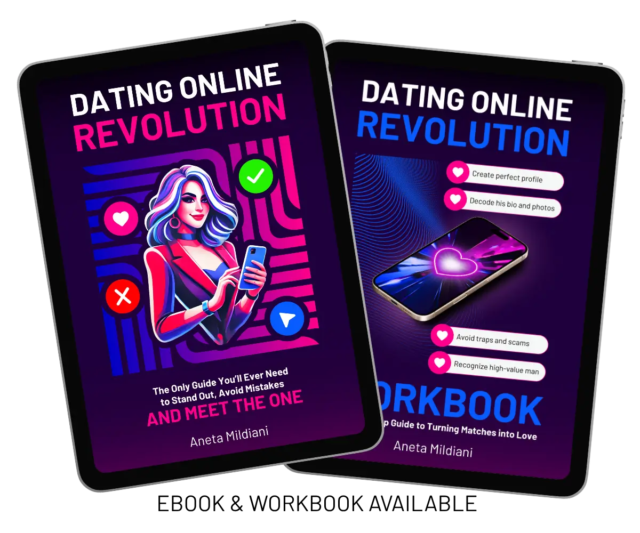
That’s why I wrote eBook Dating Online Revolution: The Only Guide You’ll Ever Need to Stand Out, Avoid Mistakes and Meet the One.
In this guide, I walk you through every critical stage of online love: how to spot red flags before you’re too emotionally invested, how to attract the right kind of partner from the very beginning, and how to protect your heart without closing it. Because online dating isn’t the problem, lack of strategy is. And when you don’t have a clear map, it’s easy to confuse intensity with compatibility, or effort with true commitment.
If your heart is online, give it something solid to stand on
If your relationship began online and you haven’t met yet, or if you’re about to enter the world of dating apps and video calls, I truly encourage you to read Dating Online Revolution first. It was created for you, with every insight I’ve gathered through years of coaching women just like you: women who love deeply, who want real connection, and who are ready to stop wasting time on men who can’t or won’t meet them fully.
Because love can start online, sometimes even thrive online, and it can still be extraordinary.
But only if you know how to tell the difference between illusion… and something real.
Sources and further reading
- Blow, A.J. and Hartnett, K., 2005. Infidelity in committed relationships I: A review. Journal of Marital and Family Therapy, 31(2), pp.183–216.
- Guerrero, L.K., 1998. Attachment-style differences in the experience and expression of romantic jealousy. Personal Relationships, 5(3), pp.273–291.
- Holt, J.L. and Stone, G.L., 1988. Needs, coping strategies, and coping outcomes associated with long-distance relationships. Journal of College Student Development, 29(2), pp.136–141.
- Mikulincer, M. and Shaver, P.R., 2016. Attachment in Adulthood: Structure, Dynamics, and Change. 2nd ed. New York: Guilford Press.
- Rhoades, G.K., Stanley, S.M. and Markman, H.J., 2012. The impact of the transition to cohabitation on relationship functioning: A longitudinal, dyadic perspective. Journal of Family Psychology, 26(1), pp.87–96.
- Stafford, L. and Merolla, A.J., 2007. Idealization, reunions, and stability in long-distance dating relationships. Journal of Social and Personal Relationships, 24(1), pp.37–54.
- Whitty, M.T. and Buchanan, T., 2012. The online romance scam: A serious cybercrime. British Journal of Criminology, 52(4), pp.665–684.
Disclaimer
Every article in the Library is prepared with the highest level of diligence. I draw on my professional experience as a relationship coach, cross-check every claim with credible academic sources and review relevant scientific studies to ensure accuracy. I also make efforts to keep each article up to date, revising it whenever I find new evidence or updated research. My commitment is to provide readers with information that is both trustworthy and relevant, so you can read article based on facts, not trends. However, the rapid pace of scientific and clinical developments means that it may not reflect the most current knowledge available. Please also keep in mind, that reading an article does not constitute professional advice, as every situation is unique. If you are facing a serious personal challenge, you should seek guidance from a qualified professional.